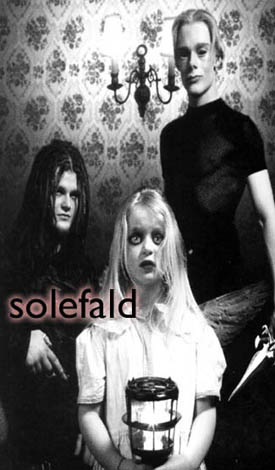
 Red. Black. A vast blinding weirdo attack. This Norwegian duo have released their second album, “Neonism”, to lots of head-scratching and similarly confounded intrigue. Made up of Cornelius (all strings/vocals) and Lazare (keys/drums/vocals), Solefald sit comfortably alongside the rest of the Norwegian Bringers of the Weird, uniquely all their own. And they’re an intelligent, inquisitive pair of guys who give metalheads a good name. The following is a conversation I had with Lazare, in its entirety. Excerpts can be found in the January 2000 issue of Metal Maniacs. Thanks to Marty for printing it all here… -by Jeff Wagner – (Taken from Worm Gear #9)
I love the new album, but I should’ve known it would take me a while to get acquainted with it.
It’s not supposed to be an easy record, put it that way. [laughing]
It’s one of those albums that gets better with every listen.
Yeah. If you listen to an album and you instantly love it, you will grow tired of it really fast, but if you’ve got an album and you listen to it and you think, “Well, I kind of enjoyed it, but I’m not sure”, then it’s going to be a really good album if you listen to it a lot of times. And I hope that’s what “Neonism” is, that kind of album.
That was my reaction to the last Arcturus album [“La Masquerade Infernale”].
What did you think about the remix album? [“Disguised Masters”]
I think Garm’s starting to blur the lines between his bands [Arcturus and Ulver], and that can be dangerous. Some of it’s really good, some of it I could live without. I don’t think they need to capitalize on the originals, they’re pretty much perfect as they are.
I agree. But it’s interesting to hear technological versions of music. When you listen to “La Masquerade Infernale”, you hear that, wow, this could be a really good techno tune, even though it isn’t. It satisfies me, in a way, to hear [“Disguised Masters”], because they do with the songs what I wanted to hear, just for curiosities sake.
So what is the deal with Norway? It’s an incredibly significant, creative music scene. I’m not necessarily talking about black metal, I’m talking more about the post-black metal stuff: In The Woods…, Arcturus, Beyond Dawn, Dødheimsgard, The 3rd And The Mortal, Fleurety, Ulver, Ved Buens Ende, and you guys are right in there. None of the bands sound alike, but they’re all massively creative.
The thing about Norway is that we kind of started the whole black metal movement in the late ’80s, and we’ve grown quite tired of it. I mean, you have tens of thousands of bands playing that straightforward black-as-you-get-it metal, and it seems Norway’s at the front of the avant-garde when it comes to reinventing the genre. Since so many bands have done that, new bands come and do the same thing, but in their [own] ways. So it’s kind of like when a country gets a really good skier, for instance, then they suddenly get a lot of new really good skiers as well, because that one skier inspires them, and I think that’s one of the reasons why Norway’s got so many great bands nowadays, is that we had all the inventors, and when the kids sit down and listen to it, they get inspired to make music themselves, and then all of a sudden you have a bunch of new great bands.
Unlike black metal, though, it seems like it would be a difficult thing to emulate–it doesn’t seem that easy to just throw together something that sounds like Beyond Dawn meets Arcturus or something.
No. Norway is a really small country. We’ve got four-million inhabitants.
Which is a third of the city I’m talking to you from right now.
Yeah! [laughing] Kind of puts things into perspective, doesn’t it? So that’s why we have to make use of all the resources we can use, which means that we cross musical borders. If we want to a guy to play this great guitar solo on our album, we have to contact some guy who’s not necessarily within the black metal movement or not necessarily into the music. And I think that has happened a lot as well, with different bands that team up with people who haven’t actually had anything to do with the black metal genre before, but presented to it, they kind of twist it because of their view on the music. That might be an explanation as well.
What does “Jernlov”, your demo, sound like?
It’s kind of more diehard, in a way. It’s more black metal. It still has these other kinds of elements. We have this bagpipe part on the demo. “Philosophical Revolt” and “When The Moon Is On The Wave” was also represented on the demo, but in slightly different versions. It’s rawer. We actually recorded that demo in a barn, because a friend of ours had this eight-track recorder in the barn, because he’s a farmer–
True Norwegian Country Music!
Yeah! [laughing] You could say it’s an alternative kind of country music. But anyway, it turned out okay, and all of a sudden we had all these record companies knocking at our doors.
I didn’t see the name around that much before the album came out.
No, because we got picked up before we even did an interview. It all happened before people began to write about us. I think we did one interview before we recorded the first album, and that was with Isten magazine, the Finnish magazine.
Oh man, I love Isten! Amazing.
That’s two twisted minds making that magazine.
Absolutely. What does the word “jernlov” mean?
It means “the iron law.” That lyric was inspired by a painting made by Odd Nerdrum, who also painted the cover on “The Linear Scaffold”. He’s a Norwegian contemporary painter, very controversial in the way that he mixes new ideas with an old way of painting. A very naturalistic approach to his paintings. He does all these weird paintings set in this environment that’s completely dead. Nothing’s alive, there’s not a flower or a tree or anything. There’s just people with really old clothes and sometimes machine guns, guarding waterholes and stuff. So it could be about a post-Third World War society, something like that.
Tell me about this death-threat you received during the time of “The Linear Scaffold”.
Well, it was from the States. I got this email from this guy calling himself this sort of Aryan/Nazi/Satanic, uh, well, dweeb. [laughing] He wrote, “Well, if you ever go to the States, you’ll be sent back in pieces.” He wasn’t really clear in what he expressed, but I think it had to do with our approach to the music. We play black metal-like music, but we’ve never been into that Satanism stuff, so I think it had something to do with that. The funny thing about it is, he wrote about his own Satanism, and he said he had this kind of esoteric Satanism, based very much on the Kabbalah, and earlier in the letter he called us “gay Hebrew nigger monkeys,” or something like that–really impressive stuff–and I just wrote to him and I told him that, “Well, guess what, the Kabbalah is actually Hebrew, so there you go,” and I never heard from him again.
You brought up an interesting point. In your music there’s definitely a very black metal thread running through there, but there seems to be some contention whether you have to be Satanic to play black metal, or is it just the sound that makes it black metal?
I think in the very beginning, black metal was about Satanic lyrics, so in that respect we don’t play black metal at all, and neither do many of the other bands from around the world, because they don’t sing about Satan, they’ve got other, more interesting things to sing about. But when it comes to the sound, it’s stupid to say, “Well, this band is not a black metal band because they don’t have Satanic lyrics, but they play black metal music,” I think you could just rather call it, “Well, this is a black metal band, but they don’t sing about Satan.” I think it’s stupid to divide it that way. Genres are changing all the time anyway, so it’s kind of stupid to try and make new categorizations for everything. Like metal’s always done. I mean, how many genre’s are there in the metal world? About as many as there are in the techno world. I don’t even know all the names. I like to just call it heavy metal, because that’s what it is! I think you should just be proud to play heavy metal. That’s a good thing.
When people ask me what Solefald sounds like, I always respond by saying, “They’re one of the few truly avant-garde metal bands.” A lot of people like to describe weird music as “avant-garde,” but your case, it’s exactly what it sounds like. Are you comfortable with that? […I ask, not realizing the irony of asking him this directly after his previous statement…]
Yeah, we are, basically, because “avant-garde” means that you do something new, and I hope that we are doing something new, so if people want to call us “avant-garde metal,” then fine by me. I think that’s quite a good term. After all, we’re signed to Avantgarde Music, so it fits!
Neonism: that could either be “neon,” as described in “Fluorescent (The Total Orchestra),” or “neo,” as in ‘new.” Both seem relevant here. Was that purposeful?
Yeah. Indeed. That’s exactly it. It’s a word we made up, and it stands for everything that is new, and everything that has to do with the new, neo world, the urban world. The thing is, most black metal bands are really kind of rural when it comes to the lyrical aspect of their music, but the fact is that most of these bands are situated either in Oslo or Bergen, which are quite urban areas, so we just thought, why should we do this rural approach when we actually are urban people?
What city do you live in?
In Oslo. It’s really a small town, but it’s the biggest town in Norway.
Is the album cover Oslo?
No, it’s actually Times Square. We contacted this fashion photographer in Norway about the cover and the band picture, and we just had a meeting with him to discuss some ideas, and he said, “I have this idea about this little girl looking really absent in a very urban environment.” A few weeks later he went to New York to do some fashion photos, and he took that picture for us.
The background or the whole thing?
The background. The picture of the girl was taken at the same time the picture of the band was taken. So we just mixed those two together.
Can you further explain her relation to the city and the neon and the whole urban thing?
It’s a five-year-old girl, and if you look at the cover, she’s really absent, you know? She’s there but she’s not there at all. And that’s how I feel many people react to ultra-urban environments. They distance themselves. Totally.
I can relate.
Yeah, I guess you can! [laughing] You know, living in the city you do.
I just moved to the country two weeks ago, and boy am I relieved.
It’s good to be out, isn’t it?
Yes, absolutely.
I would think so. The thing is, we wanted to portray this feeling of loneliness, that even though you’re surrounded by people and you’re surrounded by movement and flashing lights and things are happening everywhere, you’re standing outside it. So, that kind of relates to the whole concept of the album. It has to do with the new urban world that has intensified during the course of the last two decades. It’s doing it kind of silently, so that you don’t really notice that it’s getting harsher and harsher, and we just wanted to put our focus on that.
Coming from Norway, which is known as a vast, spacious place, do you see urbanization happening at a pretty quick rate?
Oh yeah, absolutely. People move from the country to the cities all the time. Oslo is growing like hell. It’s actually almost as expensive to buy a flat in the center of Oslo as it is to buy a flat in the center of London. So that says something about how many people want to move into the cities.
What is that? It seems more natural to want to move out.
Yeah, but Norwegians are not really used to the idea of having big cities. The biggest city is Oslo and it’s got 600,000 inhabitants, which is nothing, but it’s rapidly growing, and I think people want to be where things happen. And things happen in Oslo, and they don’t happen in Brivik, which is a really small town. So it seems that everyone wants to be urban because they really don’t know what it’s all about. It’s like, when you’ve lived in Oslo a few years, you start to get a grasp of what the city’s actually about, what’s important, what’s not important, what happens with you and what happens with people around you. But when you’ve been living in a town of 3,000 inhabitants all your life, and when you’re 20 or 21 you want to move, and you don’t really know what awaits you. That’s what attracts you to the town, I guess. You see it all over the world. All big towns in the world are rapidly growing, all the time, and even though some people are moving out, like you, for instance, more people are moving in.
What is the significance of the color red to your music? You’ve got “Red View,” “Floating Magenta,” “Proprietors Of Red,” and you’ve described your music as “red music with black edges.”
The thing about red is that it represents everything intense and everything passionate, and when we first started out with Solefald, that’s what we wanted to do. We wanted to incorporate some red into all the black, because there are too many bands who are just plain black, from A to Z, but we wanted to add something else to the music. We started out with black metal and we just did it our way, and we found that we actually had added something else to it, something more passionate and more intense in the aspect of feelings. So we just found that the color red really represents all those feelings quite well, so let’s just incorporate that into the black, so it turned out to be “red music with black edges,” because the red is the important thing in this, and then there’s the black frame, so to speak.
Tomas Skogsberg was largely known as a death metal producer. The first thing he was known for producing outside of that realm was Katatonia’s “Discouraged Ones”, and now you’ve utilized his services. What led you to him?
When we first started discussing what studio to use, we had actually made most of the songs for the album, so we knew that it was not going to come out as a straight metal album, so we wanted to have a straight metal sound to it, and we thought about Sunlight, because they have this purely analog studio. You can listen to all the old albums recorded there, Dismember and Entombed, and you listen really carefully and you hear there’s nothing digital in there, it’s pure sound, straight on. We wanted that approach, so we just took it to Tomas and asked him when we could come, and we said, “Okay, just call Avantgarde Music and arrange the payments,” so that was it.
You mentioned in a previous e-mail how you discovered the secret to that Entombed/Skogsberg guitar sound. Can you explain that again?
Yeah! They’re recorded on Peavey Bandits. They’re between the practice amps and the smallest stage amps. They’re actually really small. Before we recorded, they actually packed the amps in this foam rubber stuff first, and then they turned the volume up to maximum, so it was a really weird way of recording the guitars. They said, “Well, this is the way we always did it,” and we said, “Okay. We trust you!” I think it came out great.
So the result, “Neonism”, is a marriage of your avant-garde approach and traditional, simplistic recording techniques.
The idea was that it should make the music a bit more easily accessible for people, because I think quite a few people were scared away by “The Linear Scaffold” because of our approach to the music, and also because of the high-pitched screaming. I think he screamed some people away! [laughing]
The bio for Neonism says your “musical expression has moved back to your older influences such as Metallica, Sepultura, Judas Priest and Faith No More, while at the same time pointing forward into what is yet to come in the world of metal.” It certainly points forward, but out of those four bands, the only one I can really see is Faith No More, around the “Angel Dust” era. As far as Priest, Sepultura and Metallica goes, I don’t hear it.
You don’t?
No.
Well, if you sit down and listen to Neonism and just listen to the guitars, I think you’ll hear them. Quite a few of our guitar riffs are straightforward metal riffs in the vein of, for instance, Slayer. Take the end of “Proprietors Of Red,” for instance–you have this straightforward metal riff, but we have the synthesizers and vocals on top of it, so it’s not really easy to hear. The thing is that we have been very much inspired by those bands while writing the material. I’ve been listening to all kinds of music, but lately I’ve been returning to the old albums, my old vinyl records. I put on “…And Justice For All” by Metallica, and I just want to make that kind of music, as well.
That music is very epic.
Yeah. With songs eight-and-a-half minutes long and stuff. Very few bands do that nowadays. So I think they have been a great inspiration. As far as other bands, we both really enjoy good technological music, like Massive Attack or Square Pusher. I’m a huge fan of Lamb, which mixes jazz and breakbeats, which is totally brilliant. I saw them live here, one week ago, at a festival in Norway, and I was just totally blown away. It’s the best concert I’ve ever been to. They’re from Manchester, England. It’s a completely new band, they just released their first album. It’s definitely worth checking out. I have also been very much inspired by the progressive movement from the ’70s: King Crimson, early Yes, early Genesis. And the new Swedish progressive movement, with Landberk and Anekdoten.
Will it always be just you and Cornelius in Solefald?
The thing about Solefald is that we are two people and we do everything. If we can’t do it then it’s not going to be done. I play drums, I play all the keyboards and do all the samples and programming, and I have all the clear voices, while Cornelius plays all the strings and he does all the other vocals.
I saw a picture of you in Rock Hard, a live review, where Cornelius was wearing this weird facepaint, and this funny, uh, chapeau, so you obviously had other people with you.
[laughing] We went on a European tour with Tristania just before Christmas, and I think we kind of pissed a lot of people off about Germany with our approach to music and our way of acting on the stage. In a way, Germany is kind of a conservative metal market, and Tristania came through, which is your average doom metal with beautiful female vocals kind of band, and then we opened for them. We played for half an hour and we went off stage and people didn’t really know what hit them. We had great fun, and we made quite a lot of fans, and some enemies as well.
The way it should be.
Yeah. When you play our kind of music, that’s the way it has to be.
You’ll probably get equally aggressive criticism when people hear the lyrics to “CKII Chanel N.6,” the “Coco Chanel, welcome to hell” and “the truth as it was told to me by Calvin Klein” lines, which are just really bizarre.
Well, I hope we get reactions. In one way, that song is about the fashion world, and in another way it’s about human relations in general. We just want to use known products and known people to force people to react to something. There’s CK1 and Chanel N.5, and we’ve taken them one step further, so it’s “CKII and Chanel N.6”. For some reason, people find that very provocative, which is really good for us because that’s what we wanted. In the other lyrics, we mention people in the real world, we use real people in our lyrics to make people react, and it’s working. The album hasn’t been released yet, only the promo CD, and people are reacting like hell already.
I didn’t even know Coco Chanel was a person, which shows you how familiar I am with that whole thing.
She was the biggest diva in the fashion industry in this century.
Are you criticizing the fashion industry?
In one way, while in another way we’re not. I’m a huge fan of designers like Jean-Paul Gautier, Vivian Westwood and Alexander Queen, they’re like the avant-garde of the fashion industry, and we like that aspect of it, forcing people to react, because they are breaking with all the norms, which is, in a way, what we’re trying to do with our music. At the same time, you have to be negative to some parts of the fashion industry because of the signals they send out. The fashion industry is killing people every week, from girls starving themselves to death to glamorizing the use of heroin and cocaine. You know, the “heroin look” has been in for a few years, and it builds up under this sick ideal which kills people. People usually don’t think about it that way because the fashion industry is kind of mainstream, even though they set the mainstream, it turns out to be it, and that’s why people usually don’t react to it. So that’s also what we hope to achieve with some our lyrics, that people see the fashion industry with new eyes.
One other lyric I wanted to talk about is in “Backpacka Baba”: “White man came from across the sea, to wipe my ass with tabloid paper.” Not having seen the lyric sheet, the only way I interpret that is it’s about man’s ill-conceived attempts to go into “uncivilized” civilizations and modernize them and preach to them about the “real” world.
That is kinda what we wanted people to think about that, because every society that is not western has had this process of westerners coming in and showing people what’s right and how to live, and what to do and how to do it. Whether the people wanted to listen to them or not, they’ve been forcing them to do it, which of course is the wrong way of doing things. It always has been, from the colony times up to today. You still have Christian missionaries going to Africa to “save” people.
Who don’t need saving, who are perfectly fine as they are.
Yeah. That’s what I think. That whole lyrics is about a European backpaper who goes to India and swaps lives with one of the salesmen on the beach. What happens in the end is he’s stuck on this beach selling all this stuff while the other guy takes off to Europe with this other guys clothes and stuff, swapping lives. The basic idea was that it was kind of a small revenge on the western society.
Posted in INTERVIEWS
Tags: avant-garde, Avantegarde Music, Black Metal, Coco Chanel, Metal Maniacs, Norway, Odd Nerdrum, Solefald

 The tragedy! The horror! The…. boredom. The cover art, album title, and title tracks all relate to Chernobyl, and if that cataclysm were at all similar to this cd, the rest of the world would have told ’em to shut up and stop being so melodramatic. Perhaps it’s the style that gets to me. It’s just goth – not goth rock, just goth. Swirly, instrumental, tragic goth. I spent the first 12 tracks waiting for something to happen, and when it did (ooo! faster tempo!) I was still bored. Maybe I’m just the wrong reviewer for this cd, but I can’t imagine who would want 72 minutes of Clan of Xymox vocals over instrumental passages that don’t go anywhere. I can’t deny that this guy is talented (he did write, perform, record, and produce the whole thing), but I certainly wouldn’t give this 19-track behemoth another listen. – Christine
 I really can’t recall the last time I was excited about listening to grind, or reached for it willingly (although, “World Downfall” has been in the stereo a lot this past month). I can’t say that I’ve “outgrown” it per say, because like with every genre, there are influential or just plain excellent bands that never really drop out of one’s listening circulation wholly, but grind as musical medium, really ran out of gas for me. Too many bands writing insignificant/pointless songs that have nothing remotely interesting to say, not to mention too many bands all saying the same insignificant/pointless drivel musically and lyrically. Does that make sense? XXX Maniac are one of the collective “bands” (read: 1 guy doing everything, including drum programming, then a small army of people to trade off on vocals) that have nothing to say musically other than, “we’re going to kill you with quickness and then beat off over your twitching remains” with short, blasting machine drums, a bit of a punk vibe, and loads of porno sample fodder to indicate that this band does little but grind and watch people fuck. Fair enough, but does this combination and description incite much of a desire in you to run out and hear this band? Naw… me neither. Porno samples does not make one Blood Duster.
 Gristled and depraved sounding death doom, full of crawling movement and a mighty production. Sole member Emil Brake really has a full plate handling all the instruments on this opus of decrepitude, including clarinet, accordion, and banjo, but his take on death doom feels so much more adventurous and horrific than the whole of the genre, partially due to the unique guitar melodies he incorporates to live with the crushing foundation, and mainly due to the sheer misery and disgust in his vocals. Insanely guttural in depth and moisture, Emil’s pipes are blistered and grotesque, bringing “Let There Be a Massacre” even further down into the depths of hopelessness… right in the place where all doom fans want their music to be. With an audible distorted bass blasting through this material, Emil has really engineered a lot of depth to exist where there’s rarely much dimension to be found other than a crushing wall of guitars. From the militaristic march of “Boginki” where a snare, a thundering bass, accordion, and frantic screams offer a rather unsettling vibe, to the abysmal boom of “Centuries of Human Filth” where you can feel Emil’s disgust for humanity through the sweltering cracks of the doom he creates, “Let There Be a Massacre” is a lengthy, open minded, and creative slab of elite sludge. Really, if you call yourself a fan of the genre, I would consider this one an essential purchase. –Marty
 You’ve all heard that timeless adage; a band is only as good as their drummer? Well sometimes that’s not always the case. Old Paradise Lost consistently suffered from bare minimum drum embellishments, yet their first 2 remain classics in my mind. There are other examples, but escape me at the moment. Ever since Norway’s Kampfar have emerged from the contractual limbo with 2006’s “Kvass”, Dolk (which stands for “The Shirtless One”… ok…. Bad joke) and crew have victoriously upheld their own strain of pure and true Norwegian black metal. The music is a harmonious full breath of dissonant and wondrous melody by way of full chords and interesting riff ideas. Listening to this band easily takes one back to the mid 90’s where it was an exciting time for this genre. With their 4th full-length release, “Heimgang”, Kampfar have given the fans exactly what they expected… zero progression or style shift which I can completely respect. The problem? As with the last album, this material is musically full of life, but rhythmically stagnant. Perhaps it was always this way with this band, but I have never noticed it too much until they upgraded their production values, bringing the drums to the forefront of the mix. Drummer II13 gets the job done and on tracks like “Dodens Vee”, actually offers a bit of fire and tribal fills to give the more minimal segments of music the power it needs. But for the rest of this album, he’s stuck in the barren polka beat, doing bare minimum to colorize this otherwise well written music. Regardless, every track on “Heimgang” is enjoyable, with tracks like “Vettekult” showing a glimmer of musical progression with more interesting song structures and shifts in overall atmosphere. Again, if you have enjoyed Kampfar past and present, “Heimgang” will again impress you with Dolk’s desire for the ancient flame of Norge Black metal. Just try to look past the simplistic to the point of annoyance drum work and you’re all set. –Marty
 This looks totally like a Napalm Records release due to the really bad graphic design on the cover, featuring a woman (a Napalm staple that they think helps sell their products) conjuring some sort of spell over an unsuspecting Humpty Dumpty looking manchild. If I saw this in the record shop, I’d look at it long enough to chuckle, then wince in horror at the thought of yet another lame woman led band sprinkling their goth laced pretentiousness throughout the metal world. Thankfully in the case of Los Angeles’ Dreaming Dead, looks can be deceiving. “Within One” is actually quite an effective, death metal influenced and very modern sounding release. Slick to the hilt, but the riffs and arrangements tend to be very smart and sharp to the ear. There’s an undeniable aggression here that wants to maintain direct ties with the death metal underground, but the polished production keeps this from going too far beneath the tundra. Highly skilled musicians keep the riffs technically interesting while maintaining a sense for memorable riffs and song writing. DD offers some well sculpted harmonies to coexist alongside more searing moments of tremolo based rhythms and tight, moshless crunching. “Within One” benefits from nice tempo pacing as well not only within the songs, but throughout the album, finding the band sticking mainly to energetic mids, throwing in precision blast work when the song and intensity level really needs to ignite. Love her, or love to hate her, if Angela Gossow
  Ethereal acoustic music with a lyrical and musical affinity for ancient times and forgotten tales. Vocally, Swawa puts me in mind of Andrea “Nebelhex” Haugen with her smooth singing style, but perhaps she’s even a bit better singer than Andrea. As the album forges onward, her delivery gets a bit predictable in the way she follows the underlying motion and harmonic content of the flutes and acoustic passages, but I guess that’s what you get with such minimalist traditional music. Subtle choirs and simplistic synth and flute accompaniment coexist quite comfortably with Swawa’s straight forward guitar work, but to break up the content in the future, I think she’d do well in mixing up her strum patterns and chord selections a bit. Since this is on a metal label, likely being promoted to metal people, I think the metal contingent will see “Tales of Glory and Tragedy” as a bold statement and a lot more magical that it really is. Folks into the traditional folk genre of music on the other hand may likely see it as rather underdeveloped. But for what it is, “Tales of Glory and Tragedy” is a nice change of pace for the quieter nights and those moments when I want my thoughts to roam back to last years Renaissance Fair where I enjoyed Newcastle on tap and $5 turkey legs. –Marty
 Featuring Robber (Machetazo), Rogga Johansson (Paganizer, Demiurg, Edge of Sanity), and Phlegeton (Wormed, Human Mincer), Banished From Inferno specializes in deep and churning death metal by way of cavernous vocals and a strong knack for mid-paced riffage. Old school minded to the core and all about crushing in the pocket rhythmically, BFI lets the might and catchy movement within their compositions empower their attack, rather than catering to the technical tricks and unwarranted speed that has laid waste to the heart and soul of the modern death metal movement. Structurally, the songs all work perfectly as the band focuses on sensible flow and subtle dynamics in tempo and riff crafting. My initial problem with this MCD was the pacing/placement of the songs at the beginning. This slab starts off with a mournful and brief instrumental that quickly fades into silence. I thought the disc stopped actually, before an eruption of thunder from an off in the distance storm finally unsettles what seems like a solid minute of silence. From there, it’s into the bands rendition of “Into the Crypts of Rays” by Celtic Frost. I’m not opposed to this cover at all… it just seems like a very awkward place for it to be on this release. Rather than give the listener a solid demonstration of what the band has to offer right up front, it’s like they tested the waters first with a band that is clearly one of their influences. Such a decision/crutch really wasn’t necessary since the body of their material possesses the writing skill and penetratingly dense sound to keep fans of bands like Kaamos and the like completely satisfied.
 Pagan metal… I have always appreciated the combination of traditional acoustic instruments and metal, but there is no denying, or sometimes even overlooking the fruity nature of largely in-key and happy sounding metal music with equally lighthearted medieval scales. Again… the pagan folk and metal realms seem to accommodate each other well, but happy sounding music often rubs me the wrong way. I want this style of music depressive, ugly, and other worldly; NOT an elven jig out in the forest where ladies braid their hair and tend to the babies and making bread while the men compare the length of each others recently smithed swords.
  Originally conducted via the Internet in 2007 before we went on hiatus, this interview with Heer Halewyn, guitarist for
 I’m curious as to how black metal is accepted in your country. It seems that during the early 90’s during the rise of Norwegian black metal and its attack on people’s spiritual fears both in words and action, public outcry quickly spread throughout Scandinavia and the rest of Europe denouncing this music and the actions that have been known to coincide with it. Have you experienced any lingering hostility against the style of music you believe in, in your personal life? Maybe how you are treated in public? Has there been any opposition to your band playing live in your area? Is there any consequence to supporting black metal in your town in 2007, or has the public’s exposure to the music, or choice to ignore it, diffused their fear
 Earlier Celestia releases have always shown a lot of promise, but never really carried through with anything overly remarkable to my ears. Take your standard, melodic, though core underground black metal persona musically and inject a touch of gothic flair through synth accompaniment and overall dark romanticism and you have an entity that is dabbling in a lot of ideas that have been often executed by others before them with a bit more success and vision. Perhaps this is too bleak of a picture I have painted, for there is always something on their releases that I have enjoyed, enough so to keep the titles I have, but I can’t help but noticed a forced sounding air to Celestia’s past exploration. That is until now. With “Frigidiis Apotheosia: Abstinencia Genesiis”, it seems that Noktu and crew have grown quite comfortable in their creative shoes and have eased up on the compositions to really let the more catchy and dark moments of their songs to breath. This is achieved by way of creating simple lines musically. The independent musical phrases are indeed simplistic, but still quite powerful on their own and all effectively congeal together into a very poignant and memorable body of work. Acoustic guitar lines and subtle keyboard harmonies exist within slow to mid-paced rhythms that benefit from a very tight guitar tone, only to be further darkened with the tormented screams of Noktu. I may know what direction each song is going, but I’m just happy to be along for the ride as very memorable riffs carry one along as if being tugged by a warm wave of water. It is this flow and sensible songwriting style that has really opened up the future of Celestia, for this French entity has established a very dark and moving atmosphere with “Frigidiis Apotheosia: Abstinencia Genesiis”. –Marty
 What a legacy this band continues to nurture. Even bands like Entombed, someone that Dismember used to be slagged constantly for stealing their sound so many years ago, have so completely lost the faith, I rarely even remember they are still together and releasing music. Other than the one stutter step known as “Massive Killing Capacity”, where Dismember really didn’t fall apart, but concentrated more on a cleaner sound and more streamlined melodies, doesn’t in any way tarnish this bands death metal throne. “Dismember” is probably one of the best albums from this band in the past 10 years. This album is the perfect marriage of Maiden-esque melody and disease ridden Autopsy worship, swollen with the Swedish trademark, down-tuned twin axe grind. Matti Karki still possesses that dank drunk growl that makes this band so special. The production is pristine, yet full of filthy slime. “Dismember” is an effortless “fuck off” to the modern death metal bands that have taken over the genre with their machine-like speed and emotionless, out of key riff writing. 11 tracks are here, every one of them is a hook bloated statement of excellence. –Marty
 There was a time when Belgium’s Enthroned first erupted from it’s Marduk worshiping sack, that I was a bit enamored by them. Sure, I knew what I was hearing wasn’t anything new in the least, but there was always something in their songs that kept me interested and coming back for a new release. When “Armored Bestial Hell” came around, I had enough of the Enthroned tilt-a-whirl and opted to get off this ride. Too much of the same had infected their sonic crypts and when the riff work slid into redundancy, there simply wasn’t enough character or spirit in the band to keep one interested. Looking over their catalog, it is quite extensive and it seems that I have missed quite a bit. “Tetra Karcist” still feels like Enthroned of old, give or take a key member change or 2, but it seems that full on speed all the time has been tempered a bit with more mid paced and 6/8 time signatures to keep their sound more balanced. This is a good thing. Still the speed factor and hellish screams are at the forefront of this bands offensive, but they class it up a lot with traditional metal inspired solos and some well placed music breaks. A definite improvement can be heard, but the vocalist really needs a bit of creativity in both his vocal phrasing and overall shrieking style. Breaking it up with some lower growls or chanting would greatly accent the varying turns in the music. One thing that really bugs me about this album, is the overly triggered drum sound. I have never been a fan of this production staple, though I do understand it keeps the fast parts from sounding muddy, but really, it gives this entire album that slick/clinical modern edge that everyone has these days. Sure, this is probably what the band wanted, but I think a more organic overall sound would have greatly improved the feel of “Tetra Karcist”. Some really mature songwriting can be found on this album, languishing in a standard modern black metal shell that could have just as easily been Dark Funeral, or any other band striving for that piece of polished commercial blasphemy. –Marty
 “A Caress of the Void” is a monster of a death doom release. The progressions may be very slow to unveil themselves to the listener, but the payoff is a hopeless bludgeoning of de-tuned riff depression, augmented by clean guitar lines and the ever miserable death groans of John Paradiso. Bleak riffage erodes into meaty grooves and the non triggered/thick drum sound further pounds the intent of this music deeper into the soul. The last CD I’ve heard from this band was “Quietus”, which I liked, but felt was too heavily inspired by Disembowelment. “A Caress of the Void” is it’s own entity, easily one of the best albums from this genre I’ve heard in recent years. The bass guitar (Craig Pillard lends his talents on this) is audible throughout the whole album and it adds such a cavernous dimension to this material, no matter what emotion is being explored. Dynamics are key to “A Caress of the Void” and even though the songs creep along at a slug like pace, the structuring of sound is completely hypnotic, keeping me entranced by the deep layers that soak this material with atmosphere. 7 tracks, 61 mighty minutes of essential doom. –Marty
 After a 7 year hiatus, Michigan’s Feast Eternal return, more streamlined and unique in their death metal aesthetics. Where “Prisons of Flesh” was a fine cross section between Bolt Thrower and the more lofty melodies of In Flames, “With Fire” holds onto those influences, but seemingly grows in all directions. The songwriting is far more mature this time out, featuring very memorable hooks often carried by well-written harmonies that soar atop power chord/double bass supported foundations. The songs drift in and out of sensible verse/chorus styled structures, but never shy away from inspired music breaks and a solo or 2 for every song. It is this level of maturation, by way of the old school death metal spirit, that gives this band a fresh foothold in a scene they seemed to be lost in on their last outing. “Castigating the Glutton” is a standout on this album, for its quick/energetic chorus offers more of a higher register scratch in guitarist/vocalist TJ Humlinski’s otherwise deeply brutal vocal style. Sick vocals and fluid guitar riffs are at the forefront of “With Fire”. Some very well placed dynamics are scattered throughout the pacing of this album, further highlighted by Matt Skrzypczak’s solid drum performance. He may not be the most technical drummer out there, often reverting back to similar fills, but he does have a knack for coloring each track with just the right amount of nuance and flair. The production could have been a bit fuller or possess more depth, but everything can be heard and the power is there regardless, not taking anything away from the ferocity of this album. Feast Eternal 2008 is a band with a skilled ear for musical motion and a crushing delivery and it’s great to hear them back sounding full of conviction and “Fire”… har har. –Marty
 Consistent and prolific as ever, very few things change in the world of Xasthur. In most cases, I can respect that, but this project has become painfully predictable and unimaginative. Perhaps Malefic’s most potent and viable music is long behind him, but I will say, the material he continues to unearth has that chilling vibe ushered in by just plain wrong sounding riffs. It is this musical oddity that keeps me interested in what Xasthur is doing through a spin or 2 of said album, but there hasn’t been any lasting power for a long time. It doesn’t help that this band has spawned countless 1 man upstart BM cultists all too eager to rip-off Xasthur’s whole aesthetic. And really…. Malefic is just as much to blame with so many releases in such a short period of time, many featuring what sounds like the same riffage, just re-arranged. “Defective Epitaph” really is no different that all the albums before it other than acoustic drums and the use of a cello on occasion. That miserable feeling is exactly the same as it was on “A Gate Through Bloodstained Mirrors”, which once again proves that Xasthur is a musical vision stuck in perpetual arrested development. I can appreciate the underground static murkiness of the production, but it’s really time for a change. Be it a slight broadening of the style, or more of a vibrant sound production… either suggestion could inspire a much needed breath of fresh air in Xasthur’s abysmal dimension. –Marty
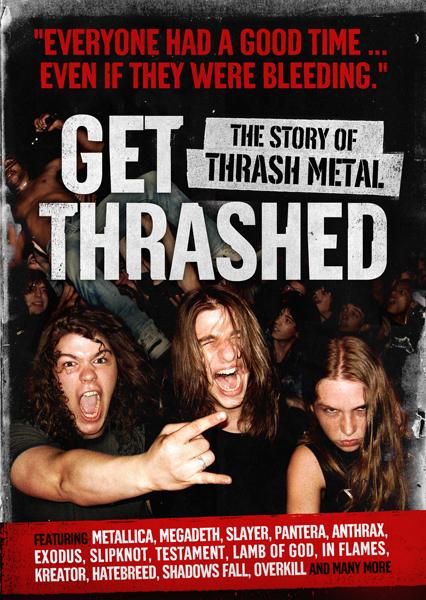 Get Thrashed chronicles the evolution of Thrash Metal from its earliest influences until it petered out. There are tons of interviews with guys still plugging away and those that hung it up long ago. The stories they relate are interesting and insightful for the most part. After the initial history lesson and run down of the impact of the “big 4” Slayer, Metallica, Megadeth and Anthrax, the musicians and commentators start to wade through some of the 2nd and 3rd wave bands offering opinions on how they helped to perpetuate the scene. Ian Christie is the default expert andgets a lot of screen time, but I found his insights less interesting than those from the old DJ’s, label owners and the musicians themselves. The old stories are predictably the most entertaining. In addition to those, there is a lot of “those guys were killer” conversation as well as some great live clips and photos from the early days.
 SUMMONING has evolved from a fairly straight forward Black Metal band on their first full length “Lugburz”, into a band without peers in the Black Metal community. SUMMONING’s richly orchestrated and densely layered passages take their time to unfold and envelope the listener, and are as flawless as they are majestic. They have truly earned their place on the throne as the undisputed patriarchs of Atmospheric Black Metal, and I see no challengers on the horizon. This interview was conducted through the mail at the end of May. – Scott – (Taken from Worm Gear #5)
 Your music is an exercise in tribute to lands and times forever dead. What is it about ancient times that you find so compelling?
 Do you feel there are benefits to coming from a place like Austria where the scene is small and potent as opposed to somewhere in Scandinavia where there is an enormous amount of bands but comparatively only a few that stand out?
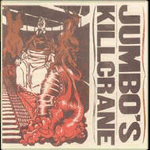 “Carnaval De Carne” is in that heavy slow groove kind of vein with a nice raw edge to it, that reminds me a little of Unsane or Rabies Caste, certainly not a rip off of either, but to understand the comparison is to have an idea where Jumbo’s Killcrane is coming from. This is fleshy, thick, dirge with a scraped yell sort of vocal approach that gets a little more “sung” at times. Nice hooks and prominent bass and low end root the mid to slow paced tracks. They use some more melodic, and even slightly bluesy riffs mixed into the dense chords progressions to break things up, as on “Tres Futbol del Mono I” that work great and add a new dimension to the release, this evolves into a lethargic droning bit of sludge. “Gasmouth” is a track that is based more around a “notey” sort of riff, than caveman chords, and again offers another angle to the project, more teetering and discordant. These kind of releases always lead me to ponder just how crushing they would sound live, the heavy low end, and the catchy hooks you just know it would be something to see. – Scott
 Worm Gear